by Betsy DiJulio
A “non-compliant bid” in response to an RFP may sound like a negative. At the very least, it is a big risk for the bidder, lest they be disqualified from the outset. But when Dills Architects presented an alternative proposal to the original brief for a new classroom with an adjoining dock from Norfolk Botanical Garden (NBG), they did so as self-described underdogs in the national search. Their “What have we got to lose?” mentality resulted in the groundbreaking “Garden of Tomorrow,” an encompassing response that communicated their desire to be strategic partners, not simply service providers.

In so doing, the Dills team, self-proclaimed lifetime members of NBG, demonstrated their deep understanding of the organization’s goals, not merely their ability to adhere to a rigid scope. According to principal and owner Clay Dills, the overarching question propelling their work was legacy-driven, “What could be incredible for the next 50 years?” From the perspective of NBG President and CEO, Peter Schmidt—who took over the helm in 2023, after serving as interim following a stint as CFO and VP of Human Resources—the driving force was mission alignment with education at its core.
Language in the original brief about education and enhanced visitor opportunities inspired the Dills team to reimagine the visitor experience throughout the entire campus, beginning with arrival. From the outset, Dills recalls that the Board members, who he said view the garden as a sacred place, could see the architects’ vision, “grabbed it and ran with it.” The City of Norfolk’s response was similarly enthusiastic and supportive. Because the project took root in 2019 and broke ground in late 2021, momentum was initially built via COVID-necessitated virtual meetings along with gatherings of real people, some 20 at a time and six feet apart, coming together to look at renderings. Schmidt underscores the vital role of “active listening” across layers of meetings and anecdotal conversations with stakeholders.
What grew out of those early conversations and plans is a national model for ecological stewardship, conservation, and public education with “transparency of purpose” at its heart, hence the vast stretches of glass. Despite dramatic post-COVID cost increases, the Dills team of half a dozen architects—about one-third to one-half of the firm at the time—was able to value engineer all aspects of the project to keep costs in check without forfeiting any fundamental elements. The board and donors, who Dills refers to as “a roomful of really committed people who made it happen,” believed in the vision and essentially said, “Keep your foot on the gas.”

The new structures are a tight but expansive south to north alignment of the Brock Parking Garden and Brock Entry Pavilion, Sentara Plaza, Perry Conservatory, Kay and Al Abiouness Skywalk, and Brock Environmental Education Center. As Dills observed, “Education bookends the whole process.”
The Parking Garden may look at first blush like a parking lot. But it is, in fact, a garden featuring permeable paving, a large underground retention pond, a rain garden, and solar infrastructure. While the trees may appear constricted, each is fed by a large cell underneath the ground that catches water and allows the roots to spread naturally to support mature tree growth. “It’s about what you don’t see,” explained Dills.
Dissolving the separation between built and natural environments is the glass-walled Entry Pavilion. Light, open, airy, and skylit, it is purpose-built to welcome and orient visitors, offer both indoor and patio dining at The Reeds Bistro, owned and operated by NBG, and host a diverse range of events.
With a shade trellis and plaza to the West of the pavilion, visitors move through a spectrum of light conditions from full sun to dappled to full shade.
High above is the roof garden or Batten Sky Meadow, which extends habitat and stormwater performance, while providing vegetables and herbs for the Bistro and offering some of the best rooftop viewing in Eastern Virginia. According to Dills, it is more elaborate with deeper berms than originally intended because of Jane Batten’s vision and largesse.
The 22’ high accessible Skywalk connects the Sky Meadow to the Conservatory and seamlessly integrates the new complex with NBG’s existing trails, moving gracefully between indoors and out. Underfoot is Trex, donated by the Virginia-based company, and throughout are railings and panels painted in “disappearing gray.” This elevated walkway, which Dills asserted “was saved five times,” provides expansive views of the gardens allowing viewers a vantage point from which they can “understand the whole connectedness of the place.”
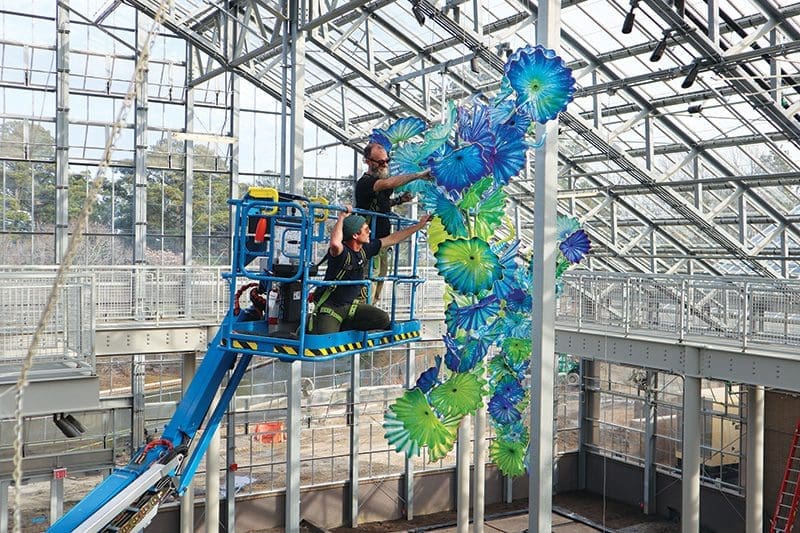
The Pavilion signals one aspect of NBG’s embrace of natural and cultural histories in a way that, as Dills described, allows “art and horticulture to reframe each other.” The Perry Family Foundation’s gift of vibrant, organic glass sculpture by Dale Chihuly forms the nucleus of NBG’s permanent art collection which appears to grow, hover, and float throughout the Garden of Tomorrow. From Schmidt’s perspective, these captivating natural forms raise awareness and forge a deeper connection to nature which translates to a desire to preserve and protect it. The Perry collection will be joined for a year by 12-15 additional glass artworks in a temporary exhibition made possible by a collaboration with the Barry Art Museum and Chrysler Museum of Art. New and ongoing community partnerships are deeply rooted in the Garden of Tomorrow.
NBG’s entrenched commitment to eco-friendliness is on stylish display throughout the Pavilion with a sustainably sourced white cedar trellis ceiling, 98% recycled floor tile, and a Yakisugi or Shou Sugi Ban “charred” cedar wall behind the bar of the open kitchen. The massive bar sports a recycled paper kick wall, terrazzo countertop inlaid with bits of recycled glass, and chandeliers with compostable mushroom shades.
Virginia Beach-based furniture designer, Philip Goold, fashioned a live edge countertop for the adjacent coffee bar and reception area from a 225-year-old red oak. The tree, whose health had been declining, had to be taken down on the property of NBG Board Member, Stephanie McSweeney, and her husband Joe. The couple feels gratified that the tree will have a second life at NBG. Said Goold of his involvement, “It was a pleasure to work with NBG and Dills to create truly one-of-a-kind countertops from this local red oak tree. This material has tons of character and a meaningful story coming from a member’s yard. Taken down years ago, milled, dried, and now turned into something visitors will enjoy for decades to come.”
The 26,000 square-foot glass-wrapped Conservatory—with high performance bird strike mitigation film—connects visitors with rare and endangered plant life from across Virginia and all parts of the world. Four climate-controlled biomes—tropical rainforest, arid/desert, Mediterranean, and subtropical—embrace the Conservatory’s mission of conservation, research, and year-round engagement. Through this work, NBG, now one of the five largest Conservatories in the U.S., is developing a network of connections with other like-minded institutions and establishing themselves as leaders in the field.
Rather than a mechanical system, a state-of-the-art “life support system” ensures that all plants flourish. Thoughtful elements, appropriate to each habitat, immerse visitors: a waterfall and pool in the tropical ecosystem feels cool and damp, while wide and gracefully winding berms and walkways in the arid ecozone evoke the experience of walking along a dry riverbed. Roman brick with high recycled content ties back to NBG’s midcentury roots helping to create what Dills terms “a cohesive campus.” The Chihuly sculptures serve to underscore both form and fragility within the landscape. Two of his chandeliers in the education and event spaces honor the Tidewater region and the WPA men and women who built the original Garden, with the latter color-matched to NBG’s azaleas.
Between the Pavilion and Conservatory is Sentara Plaza with etched sculptural lines defined by walls, ramps, and stairs, best appreciated from the Skywalk. A stage overlooked by a terrace has been carved out for community performances. This space of both communal gathering and solitary reflection is meant to promote wellness. Connecting with Sentara Health, said Schmidt, is about answering the question, “How can nature support wellness?”
Beyond the Conservatory is the Environmental Education Center, comprised of a classroom that seats 40-50, a greenhouse, a laboratory, and a staff work area. This space supports and encourages hands-on, science-based, indoor-outdoor study and innovative educational programs.
The once-in-a-generation version of the Garden of Tomorrow that will open to the public later this summer is the result of what Dills described as “will, dedication, and commitment from all parties.”
Norfolk Botanical Garden, 6700 Azalea Garden Road, Norfolk, 757-441-5830, norfolkbotanicalgarden.org